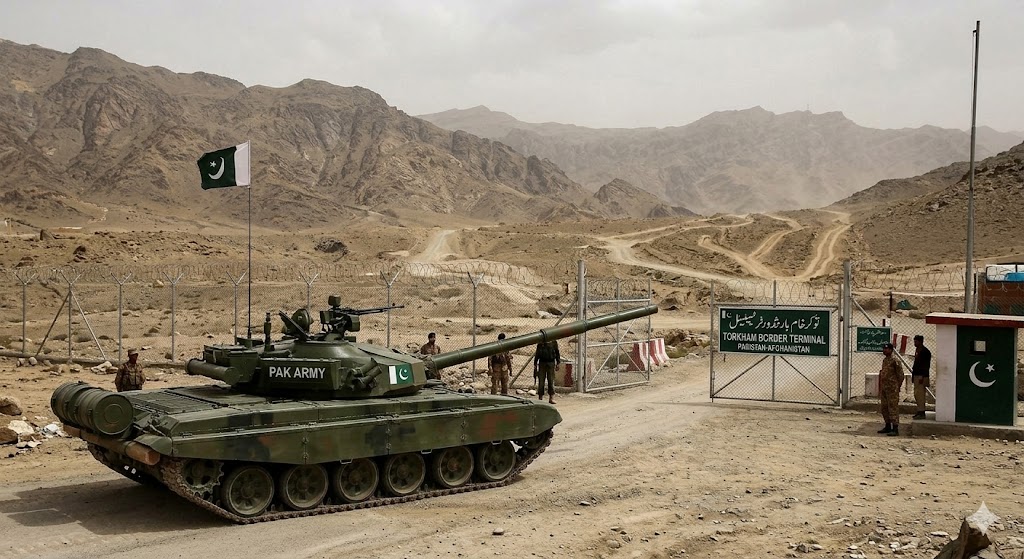
Pakistan Afghanistan border fighting intensified Friday after Islamabad declared it is now in “open war” with Afghanistan’s Taliban authorities.
Explosions were reported in Kabul, while cross-border strikes hit areas along the Durand Line separating the two countries.
Pakistan confirmed operations inside Afghan territory, including Kandahar and Paktika.
Taliban officials announced large-scale offensive actions in response to earlier Pakistani air strikes.
Why Pakistan Afghanistan border fighting escalated
Pakistan Afghanistan border fighting erupted after Islamabad launched air strikes earlier this week targeting what it described as militant hideouts inside Afghanistan.
Pakistani officials accuse Taliban authorities of allowing armed groups to operate near the border and stage attacks inside Pakistan.
Taliban leaders rejected those accusations and launched counter-operations along the Durand Line.
Kabul framed the offensive as retaliation against violations of Afghan sovereignty.
Several factors drive the escalation:
- Long-standing disputes over the Durand Line border
- Allegations of cross-border militant activity
- Retaliatory air strikes and military build-up
- Rising political pressure in Islamabad and Kabul
The Durand Line remained contested for decades.
Pakistan recognizes it as the official international boundary. Afghan governments historically dispute its legitimacy.
That unresolved tension continues to fuel periodic clashes.
United Nations urges restraint amid Pakistan Afghanistan border fighting
United Nations Secretary-General Antonio Guterres is closely monitoring the situation.
Through spokesperson Stephane Dujarric, Guterres:
- Expressed deep concern over the escalation
- Urged strict adherence to international humanitarian law
- Called for immediate protection of civilians
The UN emphasized the urgent need to prevent further destabilization in the region.
Iran calls for dialogue during Ramadan
Iran urged diplomatic engagement. Foreign Minister Abbas Araghchi encouraged both sides to resolve tensions through dialogue and good-neighborly principles.
He highlighted Ramadan as a time for restraint and affirmed Tehran’s readiness to facilitate constructive talks between Kabul and Islamabad.
Russia and China push diplomatic solutions
Russia called for an immediate halt to cross-border attacks.
The Foreign Ministry indicated Moscow could mediate if both governments agree.
Meanwhile, China voiced deep concern over the escalation.
Foreign Ministry spokesperson Mao Ning confirmed Beijing is engaging through diplomatic channels and remains willing to play a constructive role.
China maintains strategic interests in regional stability, particularly given security and economic corridors linked to Pakistan.
Pakistan declares decisive response
Pakistan Defense Minister Khawaja Asif stated that Islamabad exhausted diplomatic avenues before launching operations.
He accused Taliban authorities of fostering instability and asserted that Pakistan’s armed forces are responding decisively to aggression.
Pakistan framed its actions as defensive measures to protect national security.
Afghanistan vows unity against cross-border strikes
Former Afghan President Hamid Karzai declared that Afghanistan will defend its sovereignty.
He urged Pakistan to reconsider its regional policies and pursue mutual respect and civil relations.
Taliban officials maintain that their operations respond directly to earlier Pakistani air raids.
Regional stability faces renewed pressure
The Durand Line has long remained a flashpoint between Islamabad and Kabul. However, the latest Pakistan Afghanistan border fighting signals a sharper military confrontation.
Analysts warn the escalation could:
- Disrupt trade routes
- Trigger displacement along border provinces
- Strain regional diplomatic alignments
- Increase militant activity
Global institutions continue to monitor developments as both sides mobilize forces.