
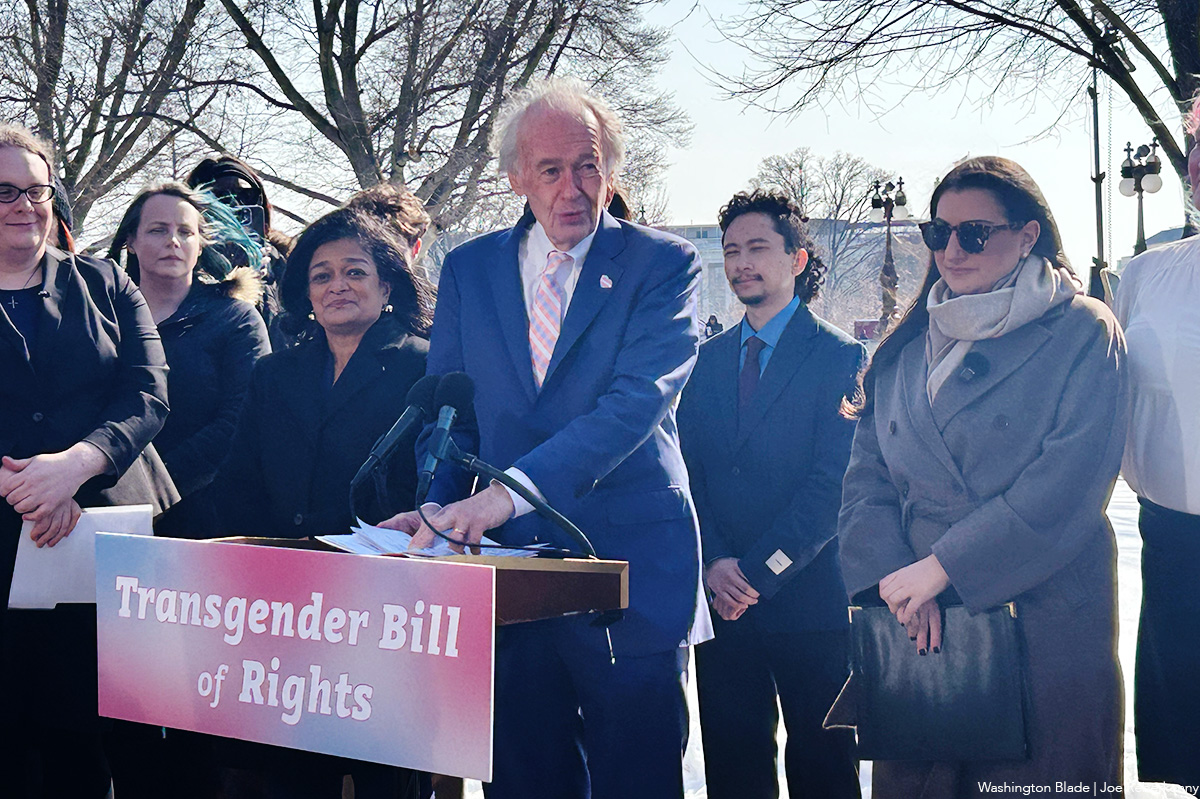
WASHINGTON, D.C. — Congress top Democrats reintroduce Trans Bill of Rights as lawmakers gather outside the U.S. Capitol to outline new federal protections for transgender and nonbinary Americans.
U.S. Sen. Ed Markey (D-Mass.), along with U.S. Reps. Pramila Jayapal (D-Wash.) and Sara Jacobs (D-Calif.), formally reintroduced the resolution in Congress.
The proposal seeks to codify protections related to health care, housing, safety, and economic security.
The move comes amid growing national debate over LGBTQ policies and recent actions by the White House and several state governments.
What the Trans Bill of Rights Would Do
Lawmakers describe the resolution as a comprehensive framework to expand and clarify federal protections for transgender and nonbinary people.
The proposal aims to:
- Amend the Civil Rights Act to explicitly protect gender identity
- Safeguard access to gender-affirming medical care
- Prevent discrimination in housing and public accommodations
- Protect access to legal gender recognition
- Ensure equal access to education and employment
The resolution states that the federal government has a duty to protect and codify these rights under federal law.
Lawmakers Outline Purpose in Congress
Sen. Markey is leading the resolution in the Senate, while Rep. Jayapal is spearheading efforts in the House.
Markey emphasized that the bill seeks to guarantee equal protection under federal law for transgender Americans. Jayapal described the measure as a vision for equal opportunity and equal treatment nationwide.
Rep. Sara Jacobs, co-chair of the Congressional Equality Caucus’ Transgender Equality Task Force, pointed to increasing legislative actions in several states that affect transgender individuals.
The bill has broad Democratic support.
In the Senate, co-sponsors include Sens. Jeff Merkley, Elizabeth Warren, Mazie Hirono, Ron Wyden, Martin Heinrich, Alex Padilla, Bernie Sanders, and Peter Welch.
Nearly 100 House members have signed on as co-sponsors.
Rising Legislative Activity Across States
The reintroduction follows increased legislative activity related to transgender policies at the state level.
According to the Trans Legislation Tracker, more than 1,000 measures affecting transgender individuals were proposed nationwide in 2025.
These proposals range from health care restrictions to policies affecting school participation and public accommodations.
Advocates argue that federal protections are necessary to create uniform standards across states. Critics maintain that states should retain authority over many of these issues.
Public Response and Advocacy Voices
Advocacy groups attended the Capitol event, including representatives from Advocates for Trans Equality and the American Civil Liberties Union.
Speakers highlighted concerns about access to medical care, legal documentation changes, and discrimination protections.
Supporters argue the resolution provides a federal safeguard in response to varying state policies.
Meanwhile, opponents of expanded federal protections have expressed concerns over regulatory scope and the impact on existing state laws.
Political Context in Washington
The reintroduction takes place amid heightened political debate over LGBTQ rights, education policy, and federal authority.
While Democrats frame the proposal as a civil rights measure, Republicans have signaled resistance to broad federal expansion in this area. As a result, the resolution faces uncertain prospects in a divided Congress.
Nevertheless, Democratic sponsors indicate they will continue advancing the measure in both chambers.
The resolution now moves through congressional procedures in both the House and Senate.
Key next steps include:
- Committee review
- Potential hearings
- Floor consideration
Given current political divisions, passage remains uncertain.
However, supporters view the reintroduction as part of a longer-term legislative strategy.